
5 Common Capability Statement Mistakes To Avoid

If you want to work as a federal government contractor, there are several steps you need to take, and one is the creation of a dynamic capability statement. The quality of this document is crucial, and this article includes some helpful tips as well as some mistakes to avoid.


What Is A Capability Statement?

A capability statement is something that all government contractors need to create, and it basically functions much like a resume. It provides essential information about your company, as well as contact information and data such as your Commercial and Government Entity Code, or CAGE code, which is assigned to you once you have an approved listing in the System for Award Management, the database that houses information for all government contractors.


What to Include in Your Capability Statement:

Typically, procurement agents expect to see the following sections on a capability statement:


Company Overview

This is just a short “About Us” section, where in a single paragraph you explain the goods or services that your company provides, as well as any other relevant information that federal procurement agents should know immediately about your company.


Here’s an example for a company that provides general automotive repair.


Auto Repair Experts is a VOSB-certified, full-service automotive repair facility dedicated to providing affordable, reliable repair and maintenance services for all vehicle makes and models, including complex engine diagnostics and transmission work, as well as routine services such as oil changes and brake inspections.


Core Competencies

In this section, you outline the main services that your company can provide. For the auto repair client above, the business owner should include as many services as possible so that the procurement officer has a full picture of what the business can provide.


Past Performances

This is a quick list of some of the companies or entities you have served in the past. For instance, an auto repair service might have worked with local school districts or taxi services to provide repairs and maintenance. These are the types of past performance you want to highlight as they speak to your ability to handle larger volumes of service.


Differentiators

This section details what sets you apart from other potential government contractors. For our auto repair business, the owner could highlight how many vehicles are serviced per year or perhaps any area of specialization. This is a crucial section because you could be competing against dozens or even hundreds of applicants, so you need your key skills to truly set you apart and showcase your ability to fill a government contract.


Corporate Data & Contact Information

This includes important information, including your CAGE code, UEI number, address, website URL, phone number, and the person to contact regarding the government contract. You also should include your NAICS codes as well as any small business set-aside certifications you possess.


Here’s a quick look at what a basic capability statement might look like once it has been completed:
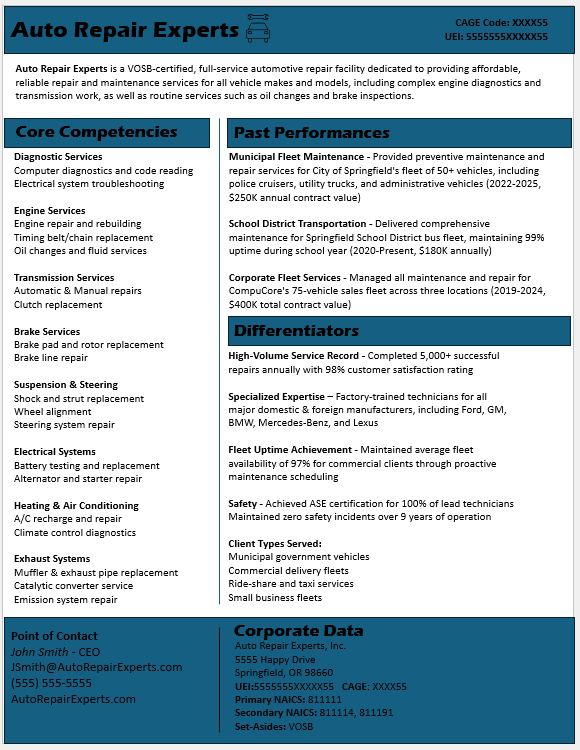
While this is a basic example, it illustrates that you need to keep the statement organized and easy to read so that procurement agents can quickly learn about your strengths and what you can provide for government agencies.


5 Mistakes Contractors Often Make

While the aforementioned information can help you get started, it also is important to learn about some of the more common mistakes contractors make, including:


  1. Making It Too Long

Similar to most resumes, capability statements should be no longer than one page. Procurement agents have limited time to review submissions, so you need to make it short and sweet, condensing the information into the most important and relevant points.


  1. Using Generic Content

While you can make a general capability statement for your website, when you turn in a statement for a specific government contract, you need to tailor it to that contract. For instance, let’s say you are an auto repair company, and the government contract specifically indicates that they need someone to provide routine maintenance, including oil changes, tire replacements, and brake inspections.


You will need to update your capability statement to ensure that it includes the specific services needed by the government agency, assuming you can provide those services. The contracting officer needs to see that you can fulfill the goals of a specific contract, so a one-size-fits-all statement is not going to help you stand out from the competition.


  1. Failing To Highlight Differentiators

While being able to provide the goods or services listed in a contract is crucial, the sections where you list Past Performances and Differentiators are the most important. You need to highlight your unique qualifications and provide quantifiable achievements rather than making vague statements. Provide examples of past clients that showcase your ability to fulfill the obligations of the government contract.


  1. Incorrect, Outdated, or Missing Information

This seems obvious, but you would be surprised how many times capability statements are handed over with serious errors or missing information. Be sure to triple-check the phone number, email address, and URL on your document. Triple-check to ensure that your CAGE code and UEI are correct.


When a procurement agent skims your statement, they use that CAGE code to look up your company in SAM. If the CAGE code is wrong, they won’t find you, and your bid likely will end up getting tossed.


Adding, the wrong NAICS codes also can cause problems. You need to ensure that these codes accurately identify the goods or services your company provides. Be sure to update these codes if your business model changes, as incorrect information is a huge red flag to a procurement agent.


  1. Poor Visual Design & Formatting

While our example above likely won’t win any design awards, it is well-organized and easy to read. You want to provide a statement that is easy for an agent to scan quickly, and you want to keep the fonts, colors, and general design consistent throughout. Our statement above did not include a company logo, but your statement should include your logo, as it gives the statement a professional touch.


We recommend browsing the internet for good examples of a well-designed capability statement for government contractors. There are companies that will prepare this statement for you, just as there are services for those needing a professional resume.

How To Get Started With Government Contracting

While designing a capability statement is essential, the first step toward becoming a government contractor is to register in the System for Award Management (SAM). Without completing SAM registration, you cannot bid on any federal contractor jobs, and Federal Contractor Registry can help.


The government does not charge a fee for SAM registration, but the process is complex and time-consuming (10 or more hours on average). If you make any mistakes, this can delay your approval, and you may miss out on contracting opportunities. Many company owners simply hire a third-party SAM registration service.


In addition to quickly and accurately completing your SAM registration (or SAM renewal), we also will help you obtain your UEI number and help with the SAM notarized letter requirement.


Additionally, if you qualify as a small business, we can help you sign up with SBA and determine if you qualify for any small business set aside, such as the 8(a) Business Development program, HUBZone certification, or others. These can make it easier for small business owners to win federal government contractor jobs.


At Federal Contractor Registry, we make it easier for business owners to get started with contracting by providing fast, efficient SAM registration services that save you time and allow you to focus on running your business as well as creating a dynamic capability statement. If you would like to get started with SAM registration, just click on the green New Registration tab on our homepage and fill out our quick contact form.


SAM Government Contracts: A Guide For New Contractors

Interested in bidding on SAM government contracts? Getting started can be tricky, but at Federal Contractor Registry, we can help. Not only can we provide you with fast, accurate SAM registration services, but we also have a plethora of information that can help contractors get started.


SAM Registration: The First Step

The System for Award Management (SAM) is a database that houses information about all government contractors. In order to work with any federal agency, you need to have an active listing in SAM, so this is typically the first step business owners take before getting started with government contracting.


Before you can register in SAM, you must procure a Unique Entity Identifier (UEI). This UEI number is a relatively new requirement for contractors. Previously, the government asked you to provide a Data Universal Numbering System code, or DUNS. DUNS were generated from a government contractor, but the federal government decided to create the UEI system and streamline the process. We can help you obtain your UEI if you choose to use our services for your SAM registration.


You also must submit a notarized letter to the Federal Service Desk listing your company’s Entity Administrator. This is the individual at your company who is authorized to make changes to your SAM account. We also can help you with this SAM notarized letter requirement if you choose to have us complete your SAM registration.


SAM registration can be extremely complicated and time-consuming, which is why many business owners hire a third-party registration service to complete this task. At Federal Contractor Registry, we provide fast, 100% accurate SAM registrations for companies from any industry.


Once we complete your registration, it typically takes a few weeks for the government to approve the listing. After you are approved, you will receive a Commercial and Government Entity Code, or CAGE code. Once you have your CAGE code and an active SAM listing, you will be eligible to bid on federal contracts.


Small Businesses & Government Contracting

If your business qualifies as a small business, it is essential that you register with the Small Business Administration (SBA). Many federal contracting jobs are set aside specifically for small businesses. These are known as a small business set aside contract, and if you decide to use our services, we can help you sign up with the SBA.


You can register with SBA as a general small business, but there are several SBA contracting programs for specific types of small businesses. For instance, if your business is located inside a Historically Underutilized Business Zone, or HUBZone, you may qualify for HUBZone certification.


If your company is 51% or more owned and operated by a woman, you may qualify as a Woman-Owned Small Business, or WOSB. If your company is 51% or more owned by a veteran, you may qualify either as a Veteran-Owned Small Business (VOSB) or perhaps as a Service-Disabled Veteran-Owned Small Business (SDVOSB).


Lastly, you also might qualify for the SBA’s 8(a) Business Development Program. This program was created to help small businesses owned by socially and economically disadvantaged individuals who wish to bid on government contracts. If you earn an 8a certification, you also will have access to SBA mentorship and training.


Capability Statement – Why They Matter

Every government contractor, regardless of size, needs a capability statement. This is basically a resume that you will provide for all procurement agents. You can submit this statement with your bids, and you also can send it directly to procurement agents to promote your business. You will be expected to have this document, and it’s important to create a dynamic statement that sets your company apart from the competition.


We also recommend that you place this document on your company website so that procurement agents and prime contractors can take a look at this document if they are considering working with your company.


Typically, a capability statement includes the following sections: Core Competencies, Past Performances, Differentiators, and a brief company profile. It also should include your CAGE code, NAICS codes, Product Service Codes, and, of course, contact information, as well as any certifications, such as small business set-asides.


How To Find Government Contracts

The System for Award Management is a great place to start, as this includes most government contracts, both active and inactive. Here’s a step-by-step example of how to find potential federal contractor jobs via SAM.


  1. Head to SAM.gov and select the Contracting tab on the homepage.


  1. Under the “Search Opportunities, Awards or Subcontract Reports,” you will see a search bar. Select “Contract Opportunities” and then enter your NAICS code into the box. This typically produces the closest match to what you can provide for the federal government.


For our search, we used 561720, which is the NAICS code for janitorial services. This is just one of thousands of goods and services that the government needs in the course of a fiscal year. NAICS stands for North American Industry Classification System, and it includes codes for just about any industry imaginable. We can determine which codes best fit your business, or you can go to Census.gov to find your codes.


  1. Once you’ve entered this information, contract opportunities will appear, but this also opens up an expanded search option. We further limited the search by heading to the “Status” tab and unchecking the Inactive tab. Under “Place of Performance,” we selected Florida for our janitorial services company.


  1. Once these items have been checked off, you can scroll down the page to discover if there are any matching contracts.


We found several matches, and when you find a match, click on the entry and read it carefully. The entry will feature the contract’s classifications, which may include a small business set-aside. If you are a small business, you are eligible to bid for the contract. The contract information also will include the primary point of contact, and there should be an attachment providing all of the information about the requirements of the contract.


From there, if you believe your company can fulfill the contract at a competitive price, you can prepare your bid and then submit the offer through the SAM.gov portal before the contract submittal deadline.


There are many companies that, for a fee, will help you create and submit a bid, and many government agencies host workshops that can help you better understand the bidding process. The SBA also provides information to help small business owners learn more about government contracting, and we recommend that you take advantage of whatever resources you can find.


Additionally, if you qualify for SBA’s contracting assistance programs or as a general small business, you could search for subcontracting opportunities via SBA’s SUBNet. Subcontracting is a great way to get started with federal contracting because the prime contractor handles the bidding process and communicates with the procurement agents, and you simply handle a portion of the contract.


In some cases, SAM registration is not required for subcontractors. However, there are many contracts that require the prime contractor to use only certified small businesses and businesses with active SAM registrations, so it’s usually best to keep your SAM account active as well as keep an updated profile with SBA.


SAM registration expires every 12 months, and we can provide you with fast SAM renewal services. We recommend that you renew at least six weeks before your renewal date. It can take several weeks for the government to process renewals, and some procurement agents won’t consider contractors whose SAM registration is nearing its expiration date.


Contact Us For SAM Registration Services!

If you are interested in bidding on SAM government contracts, the team at Federal Contractor Registry is always here to help with SAM registration. To get started, simply click on the green New Registration tab on our homepage and fill out our quick contact form.

Need A SAM Number? Federal Contractor Registry Can Help

Government contracts can provide excellent revenue streams, but you’ll need an active SAM number to bid on these contracts. At the Federal Contractor Registry, we can assist you with this complex process and provide several other helpful services. Let’s dive in and take a look at the SAM registration process, our services, and some strategic considerations for federal contractors in 2025.


What Is A SAM Number?

The System for Award Management (SAM) is a database that contains information about all federal contractors. In order to appear in this database, you must complete SAM registration. Once registration is complete and your listing is approved, you will be assigned a SAM number, which is more formally known as a Commercial and Government Entities code, or CAGE code.


At Federal Contractor Registry, we handle hundreds of SAM registrations every year for all types of businesses. The government does not charge a fee for registering in SAM, but it is a very complex process, and if you make any mistakes, this can delay your approval. Our team provides fast and 100% accurate registration services, so that you can begin bidding on government contract jobs as quickly as possible.


In addition to helping with SAM registration (and SAM renewal), we include the following tasks in our registration fee:

  • UEI Number Assistance – The Unique Entity Identifier, or UEI, is a new step that federal contractors must take when first completing SAM registration. This number replaces the requirement to provide your DUNS number. We can help you obtain this number as quickly as possible.
  • The SAM Notarized Letter Requirement – All new SAM registrants must submit a notarized letter to the federal government listing their Entity Administrator. This is the individual at your company who is authorized to make changes to your SAM listing. We can provide you with a template for this letter to make this process much easier.
  • SBA Government Contracting Assistance – The Small Business Administration (SBA) offers many programs for small business owners interested in government contracting, and the federal government sets aside a portion of all contracts just for small businesses.


These are known as set-asides, and there are several different options, including Woman-Owned Small Business (WOSB) set asides, Service-Disabled Veteran-Owned Small Business (SDVOSB) set asides, and several others. We can help you sign up with the SBA, link your SBA account to your SAM listing, and determine which small business set aside is the best fit for your specific company.


What Types of Federal Contractor Jobs Are Available?

The federal government procures the majority of its goods and services from the private sector, thus supporting the U.S. economy. When you think of government contracts, you might only think about huge defense contractors or perhaps disaster relief jobs, but that is just the tip of the iceberg.


Everything from copy paper to repair services are needed regularly by various federal agencies. Janitorial services, security services, marketing services and even food services are needed, as well.


To check if your company’s specific goods are services are needed, we recommend heading to SAM.gov and clicking on the Contracting tab. From there, click on Advanced Search and then search by “Product or Service Information.” At this point, you can enter your North American Industry Classification System (NAICS) codes. These codes describe the exact goods and services a company provides. You can find your codes at Census.gov.


Once you enter the NAICS codes, you should see a variety of contractor jobs appear. We recommend reading the contracts carefully to determine if you can provide the goods or services that the government needs within the exact scope of the contract requirements. If you find that there are some good opportunities for your company, contracting likely will be a good fit, and you can contact us for help with SAM registration.


Do Government Shutdowns Affect Contractors?

In short, yes, many federal contractors will be affected when the government shuts down. When this occurs, many “non-essential” contracts and roles are furloughed. Not all contracts will be considered non-essential, and it can be confusing to understand which contracts are deemed essential vs. non-essential.


Typically, contracts that deal with professional services, such as planning or training, or marketing, will be considered non-essential. Research and development projects at some agencies may be halted, as well. Even contracts that deal with facility maintenance could be halted, especially those at administrative offices.


Essential contracts are those that are considered necessary to protect public safety, national security, life and property, as well as those that are funded through multiple-year or no-year appropriations. Some contracts are funded through annually approved appropriations, and some are funded through multi-year appropriations. Contracts approved annually often are furloughed during government shutdowns.


It is important that contractors understand whether or not their contracts will be deemed essential or non-essential during a shutdown. For those potentially non-essential contractors, it’s wise to have contingency plans and financial buffers in place. Shutdowns don’t occur often, but we recommend that you confer with your federal agency contacts whenever a potential shutdown is looming to ensure that you know the best procedures to follow.


Need A SAM Number? Contact FCR Today!

If you are interested in government contracting and wish to obtain your SAM number or CAGE code, we are always here to help. To get started, head to our homepage and click on the New Registration tab. From there, just fill out our quick contact form, and one of our registration specialists will quickly be in touch to gather your information and begin your SAM registration.

Decoding CAGE Codes: Facts For Government Contractors

If you’re interested in becoming a government contractor, you likely have heard the term CAGE code. The Commercial and Government Entity Code, or CAGE Code, is something that every federal contractor needs, but why is this code important and how do you apply for a code? Let’s break down some key facts, benefits and requirements regarding CAGE codes and contracting.


What Is A CAGE Code?

A CAGE code is a five-character alphanumeric unique identifier assigned to entities (businesses) by the Defense Logistics Agency (DLA). This code is used by all United States government agencies to track contractors and ensure compliance with federal procurement requirements.


Who Needs A CAGE Code?

  • Your business will need a CAGE code if:
  • You plan to bid on federal contracts.
  • You want to sell products or services to the Department of Defense (DoD).
  • You want to acquire grants or funding from certain federal agencies.


How To Get A CAGE Code?

To do business with any federal agency, business owners must complete their registration in the System for Award Management (SAM). This database includes pertinent information about all government contractors, and you must have an active SAM account to bid on government contracts.


You can complete your SAM registration at SAM.gov, and the government does not charge a fee to register. However, the registration process and SAM renewal process can be quite complicated and take many hours (10 or more) to complete. Therefore, many business owners simply hire a third-party registration service to complete this step.


At Federal Contractor Registry, we can complete your SAM registration (or renewal) quickly and 100% accurately, so that you will be eligible to bid on government contract jobs as soon as possible. Once your SAM registration is approved, a CAGE code is assigned, and you are now eligible to bid on government contracting jobs applicable to your business.


In addition to helping with SAM registration, we also help small businesses sign up with the Small Business Administration (SBA), which offers many helpful services for small business owners who wish to bid on government contracts.


We also can help with tasks such as the SAM notarized letter requirement. In order to initially register in SAM, all business owners must submit a letter listing their Entity Administrator, which is the person who is authorized to make any changes to your SAM account.


Additionally, we also will help you acquire your Unique Entity Identifier (UEI), which is a code needed for SAM registration. In previous years, contractors were asked to provide their DUNS (Data Universal Numbering System) number, but that has been switched to the UEI number. This is a fairly quick process, but you must have your UEI before you can start SAM registration.


Once your SAM registration is complete, you will receive both a CAGE code and a Marketing Partner Identification Number (MPIN). Your CAGE Code is public, and it should be listed on your website as well as on your Capability Statement. However, the MPIN number is a private code that you use to log in to SAM. Never share your MPIN with anyone.


As a side note, your Capability Statement is a document you will need to create. It is much like a resume and includes sections such as Differentiators, Past Performances, Core Competencies, Company Data, and Points of Contact. Your CAGE codes, NAICS codes, PSC codes and other important data should be included in this document.


Can You Transfer A CAGE Code?

This is a common question we are asked after a merger or acquisition as well as when a business name changes. In short, no. A CAGE Code is not transferable from one entity to another in cases such as a merger or acquisition, but it can be with a name change. What happens to the CAGE code depends on the specific circumstances of the business change. Here’s a breakdown of different scenarios:


  1. Business Name Change (Same Ownership, Same Legal Entity)

If only the business name changes but the legal entity remains the same, the CAGE code can remain active. Supporting documentation (such as a business registration update) may be required.


As a side note, a business owner must update the name in SAM.gov and notify the Defense Logistics Agency (DLA) CAGE Program Office of the change. Typically, once you’ve updated this information in SAM, it automatically will send a notice to the DLA, but it is wise to check with the DLA CAGE Program Office to ensure that the change is made.


Many people mistakenly believe that notifying the DLA is only for government contracts intending to bid on DOD contracts, but DLA’s Logistics Information Services is used by all federal agencies and not just the Department of Defense.


  1. Mergers & Acquisitions (Change in Ownership/Legal Entity Status)

If a company with a CAGE code is acquired by another entity, the original CAGE code typically does not transfer to the new owner. The acquiring company usually needs to apply for a new CAGE code if it becomes the legal entity responsible for government contracts. The original CAGE code may be marked inactive or linked to the new company in the SAM and CAGE databases.


  1. Business Restructuring (Spin-Offs, Subsidiaries, Divisions)

If a business creates a subsidiary or a new division, the original CAGE code remains with the original entity. The new business must apply for its own CAGE code if it plans to bid on any government contracting jobs.


  1. Business Relocation

If a company moves to a new address but remains the same legal entity, the CAGE code remains the same. The business must update its address in SAM.gov, which will update the CAGE database.


Novation Agreements & Government Contracts

If you have existing government contracts, it’s important to determine if a novation agreement is necessary to transfer contract obligations to a new entity. To get started with this process, you will need to contact the procurement agent or contracting officer at the government agency with whom you have a current contract.


A novation agreement ensures that:

  • The government agency is aware of and approves the contract transfer.
  • The new company assumes all obligations and liabilities of the contract.
  • There is no disruption in contract performance.


Novation agreements typically are required when a merger or acquisition. Additionally, if a business is sold or a division of a business that has active government contracts is sold, you will need a novation agreement. If a company restructures and changes its legal identity such as an LLC converting to a corporation, novation agreements will be needed to ensure that you can keep your government contracts.


Need A CAGE Code? Contact FCR Today

We hope this article has provided some helpful information about CAGE codes as well as the importance of SAM registration. If you would like a member of the Federal Contractor Registry team to complete your registration, simply click on the green New Registration tab on our homepage.

The Small Business Government Contractor: 7 Helpful Tips

Becoming a government contractor can be a lucrative avenue for small business owners, but it requires careful planning and understanding of the process. Here are some practical tips for small business owners looking to enter the world of government contracting.


  1. Get Started With SAM Registration

Whether you have one employee or 100,000, every potential government contractor begins their contracting journey the same way – completing their System for Award Management (SAM) registration.


While SAM registration is a required step, it’s also, unfortunately, a complicated one. The government won’t charge you a fee, but the registration process can take 10 or more hours to complete. Many business owners simply hire a third-party registration service to complete this task. This saves time and the headaches associated with SAM registration.


At Federal Contractor Registry, we complete hundreds of SAM registrations and SAM renewals every year. We work with businesses of all sizes and can quickly and 100% accurately complete your SAM registration or SAM renewal.


If your business qualifies as a small business, we can help you sign up with the Small Business Administration (SBA) and we will link your SBA account with your SAM account. We also will help you with step two – which is determining which SBA certifications might fit your business.


  1. Obtain Any Necessary Certifications

The SBA exists to help boost the profitability of small businesses throughout the United States and its territories. The federal government, in general, also seeks to boost small businesses so they set aside certain government contractors just for small companies. These are known as set-aside contracts.


The SBA runs multiple programs for set-aside contracts and your business might be eligible for one or more of these programs. Your company might qualify as a general small business, but you also might qualify as a Veteran-Owned Small Business (VOSB) or Service-Disabled Veteran-Owned Small Business (SDVOSB) or perhaps as a Woman-Owned Small Business (WOSB).


Additionally, you may qualify for certain contracts because your business and a portion of your employees reside in a Historically Underutilized Business Zone, or HUBZone. The SBA also runs the 8(a) Business Development program, which helps small, disadvantaged businesses compete in the marketplace through training, technical assistance, and government contracting opportunities.


  1. Research Government Contracting Opportunities

The government purchases the bulk of its goods and services from the private sector, which means that just about every imaginable industry is needed at some point by a federal agency. Whether you provide printing services, security services, paper and office supplies, food services, repair services or something else, the government likely needs your goods or services.


All government contracting jobs are listed on SAM.gov, under the Contract Opportunities section. Once you click on that tab, we suggest doing an Advanced Search and looking for contracts using your North American Industry Classification System (NAICS) codes. These codes describe the specific goods and services that your company can provide. You can find these codes at Census.gov or we can determine which codes fit your business as we complete your SAM registration.


  1. Network & Build Relationships

We highly recommend that you attend industry days and networking events hosted by government agencies to meet key people and learn about their needs. Building relationships with agency contracting officers can be invaluable in gaining insights into what the government needs and how you can help.


Don’t forget that state governments also need contractors, and representatives from state government agencies also often host networking events for contractors. These state contracting jobs can be just as lucrative as the federal government contractor jobs.


  1. Consider Subcontracting

If direct contracting seems too competitive or challenging at first, consider subcontracting with larger prime contractors. This can help you gain experience and credibility in government contracting while allowing a prime contractor to handle most of the heavy lifting, so to speak. This is a great way to build a resume as a new government contractor.


The SBA runs a database called SubNet (https://subnet.sba.gov/client/dsp_Landing.cfm), which is just for small business owners who wish to become subcontractors. This is an excellent place to search for subcontracting opportunities. As will Sam.gov, you can search using your NAICS codes as well as location, which makes it easy to find any options in your area.


  1. Create A Top-Notch Capability Statement

A capability statement is a resume specifically for government contracting. It contains several important sections. One section will include your “Contact Information” and another section will include “Company Data” such as your DUNS number, UEI number, CAGE code, NAICS codes, GSA Schedules and SBA certifications, such as HUBZone certification or 8a certification, etc.


You also will include a section entitled Core Competencies, which details specific skills and areas of expertise that your company can provide. This section should be concise and focused, directly aligning with the needs of the government agencies you’re targeting.


Another section, entitled Differentiators, should explain what sets your company apart from the competition. This could be unique methodologies, technologies you employ, lower costs, faster delivery times, superior customer service, or any specific advantages that make your business stand out.


Additionally, you will need a section entitled “Past Performance.” This could include a summary of previous contracts or projects that are similar to the services you are offering to the government. You’ll want to mention the clients, and briefly describe the scope of work and how you successfully met or exceeded project requirements.


Sections for “Certifications & Awards” as well as “Professional Associations & Memberships” also can be added to further lend credibility to your company profile. You will need to submit this statement with government contracts and it’s wise to have this statement listed somewhere on your company’s website. If a government procurement agency finds your company through SAM, they might check out your website and will expect to see the capability statement.


  1. Bid Competitively & Wisely

Bidding competitively and wisely is essential in securing government contracts. It’s not just about offering the lowest price, but rather about providing the best value for money. This includes understanding the full scope of the project, and the expected outcomes, and tailoring your bid to meet these expectations precisely.


When preparing your bid, conduct thorough research on past contracts awarded by the agency you are targeting. This research can provide insights into budget expectations and contractor performance standards. Use this information to competitively price your services without underbidding and compromising your ability to deliver quality results.


It’s also crucial to assess your company’s capacity and expertise to ensure you can realistically meet the contract requirements. Overpromising and under-delivering can damage your reputation and your chances of future government work.


Furthermore, consider the long-term benefits and potential follow-on contracts when deciding on your bid strategy. Establishing a track record of successful, value-driven deliveries can lead to more opportunities.


Each bid is a chance to build a lasting relationship with the government agency, so consider each contract as part of a broader strategy to secure ongoing work and referrals within the government sector.


Get Started With Government Contracting

While it can take some time to win your first government contract job, becoming a government contractor can be a lucrative option for many small business owners. If you are ready to get started and would like for us to complete your SAM registration, just click on the green New Registration tab on our homepage and fill out our quick contact form.

What Is A CAGE Code? Understanding Federal Terminology

When you first enter the world of government contracting, you will be hit with a barrage of unfamiliar terminology that might leave you a bit baffled. For instance, you might wonder “what is a CAGE code,” or “what is an MPIN?” Here’s a brief explanation of some of the most common terms that you might hear as well as some information about how to get your CAGE codes and MPIN.


  1. SAM – This is the System for Award Management, which is a federal system that consolidates several federal procurement systems and the Catalog of Federal Domestic Assistance into one new system, including the functionality from the Central Contractor Registry (CCR). You will occasionally hear someone still talk about central contractor registration, but that is no longer the correct term, instead, we call this SAM registration.


  1. CAGE Code – If you’ve been wondering what is a CAGE Code? This stands for Commercial and Government Entity code, and it is the unique identifier you receive once your SAM registration has been completed and approved. This important code should appear on your government capability statement as well as any bids you submit as government procurement agents will use this code to look up your company in SAM.


  1. MPIN – This stands for Marketing Partner Identification Number, and this is a number that you will create as a security measure to use with the System for Award Management. Unlike the CAGE code, which you will give out freely to government agents, your MPIN should never be given to anyone, as this is essentially a password.


  1. FAR – Federal Acquisition Regulation: The primary set of rules in the Federal Acquisition Regulation System governing the “acquisition process” through which the federal government purchases goods and services.


  1. RFP – Request for Proposal: A solicitation document issued by the government to prospective contractors. An RFP outlines the contracting agency’s needs and evaluation criteria for awarding a contract.


  1. RFQ – Request for Quotation: A solicitation typically used when requirements are not complex. An RFQ seeks a quote for the cost of meeting a specific need.


  1. IFB – Invitation for Bid: A formal solicitation for contractors to submit a bid to perform a specific task or project, typically used in sealed bidding procurements.


  1. IDIQ – Indefinite Delivery, Indefinite Quantity: A contracting method that provides for an indefinite quantity of supplies or services during a fixed period.


  1. GSA – General Services Administration: A federal agency that provides workspace, products, services, telecommunications, and policy solutions. The GSA offers what are known as GSA schedules or GSA contracts, and the businesses that participate essentially become approved vendors for government agencies without having to deal with the contract bidding process.


  1. GWAC – Governmentwide Acquisition Contract: A contract in which multiple government agencies align their needs and purchase a contract for goods or services.


  1. SBA – Small Business Administration: A United States government agency that provides support to entrepreneurs and small businesses. If you are a small business, we can help you sign up with SBA as part of our SAM registration services.


  1. 8(a) – 8(a) Business Development Program: A program administered by the SBA designed to help small, disadvantaged businesses compete in the federal marketplace. This is sometimes called 8a certification, and it can be a great way for a business owner to grow their company.


  1. NAICS – North American Industry Classification System: A classification system that groups businesses into industries based on the similarity of their production processes. We recommend using your NAICS codes when searching for contact opportunities at SAM.gov.


  1. DUNS – Data Universal Numbering System: A unique nine-character number used to identify each physical location of a business. The DUNS number was used for SAM registration but is being phased out in favor of the Unique Entity Identifier (UEI).


  1. UEI – Unique Entity Identifier: A new, non-proprietary identifier issued by SAM.gov to uniquely identify entities receiving federal awards, replacing the DUNS number. Anyone new to SAM must apply for a UEI number and we will help you with this as we complete your SAM registration.


  1. SDVOSB – Service-Disabled Veteran-Owned Small Business: A designation given to small businesses owned by service-disabled veterans to help them compete for federal contracts.


  1. WOSB – Women-Owned Small Business: A designation that allows women-owned small businesses to compete for federal contracts within industries where women are underrepresented.


  1. HUBZone – Historically Underutilized Business Zone: The HUBZone certification program helps small businesses in urban and rural communities gain preferential access to federal procurement opportunities.


  1. Set-Asides – These are government contracting jobs that are set aside specifically for small businesses. There are SDVOSB set-asides, WOSB set-asides, HUBZone set-asides and more.


Departmental “Nicknames”

The federal government includes more than 400 agencies and subagencies, and many of the names of these agencies are often shortened to abbreviations. Some are probably familiar, such as FEMA (the Federal Emergency Management Agency) or DOD for the Department of Defense or even HUD for the Department of Housing and Urban Development.


All of these agencies must purchase the bulk of their goods and services from the private sector, which is good news for anyone wishing to become a federal contractor. While you might have decided to become a contractor to bid on FEMA contractor jobs or disaster relief jobs, there are plenty of opportunities from other agencies.


Additionally, be sure to look beyond fed contracts. States and counties across the United States also procure goods and services from private-sector businesses, so be sure to look at your state’s procurement system for contracting opportunities.


Get Started With Government Contracting

At Federal Contractor Registry we can provide you with fast and 100% accurate SAM registration services and SAM renewal. We also will help you attain your UEI number and help you sign up with SBA and determine for what set-asides your company might be eligible.


We hope this clears up what is a CAGE code as well as some other tricky government acronyms. While the world of government contracting can seem mystifying, once you get the hang of it, this can be a great way to boost your business. If you want our team to complete your SAM registration, just click on the New Registration tab on our homepage and fill out our quick contact form.

CAGE Code Registration & Compliance: What You Need To Know

Thousands of government contracting jobs are created each year to provide federal agencies with the goods and services they need. In order to grab your piece of the contracting pie, so to speak, you must ensure that your company complies with all regulations regarding contractors, and you must complete your CAGE Code registration.


The world of government contracting can be difficult for new contractors to understand. At Federal Contractor Registry, we can help you with the registration process as well as help you understand some of the basics of contracting, including the following:


What Is CAGE Code Registration?

The System for Award Management (SAM) is the central database for everything that has to do with government contracting. All contractors must maintain an active SAM account to do business with the federal government. This registration process is sometimes called CAGE code registration, but its proper name is SAM registration.


Once you’ve completed SAM registration and the registration is approved by the federal government, you will receive what is known as a CAGE code. This stands for Commercial and Government Entity Code. It is a unique identifier given to each government contractor. When you bid on any government contracts, your CAGE code will be one of the pieces of information you will need to provide to the government.


The government does not charge a fee for SAM registration, and both Americans and foreign entities can register in the System for Award Management. While it’s free to apply, the registration process is difficult and can take 10 or more hours to complete.


Many business owners will hire a third-party entity registration service to complete the process, such as Federal Contractor Registry. While we do charge a fee for this process, we handle hundreds of registrations every year and can complete your registration quickly and 100% accurately.


We also help first-time registrants with steps such as completing the notarized letter requirement and the acquisition of the Unique Entity Identifier (UEI). For the letter, we can provide you with a template and you simply need to fill out the template, have the letter notarized and mail it to the Federal Service Desk.


The UEI number is a new requirement. In the past, companies were asked to provide their DUNS (Data Universal Numbering System) number, but this has been phased out. New registrants need to apply for their UEI, and we can handle this task for you as part of our SAM registration services.


What Do I Need To Know About Compliance?

Government contractors are subject to a wide range of compliance requirements that can vary significantly depending on the type of contract, the agency issuing the contract, and the specific goods or services being provided.


Compliance is crucial not only for winning contracts but also for maintaining good standing and eligibility for future opportunities. Here’s an overview of the primary types of compliance required by government contractors:


Regulatory Compliance

Federal Acquisition Regulation (FAR): The primary set of rules in the Federal Acquisition Regulation System, which governs the acquisition process by which agencies of the federal government of the United States acquire goods and services. FAR applies to most contracts and requires contractors to follow specific procedures and standards.


Defense Federal Acquisition Regulation Supplement (DFARS): Additional requirements that apply to contractors working with the Department of Defense (DoD). DFARS includes provisions related to cybersecurity, the protection of classified information, and more.


Keep in mind, that you can bid on DOD contracts where high security is not an issue and not all DOD contractors have to worry about protecting classified information, etc. For instance, if the DOD puts out a request for a company that can provide copy paper or office furniture, security typically isn’t a huge concern.


Legal Compliance

Employment Laws: Contractors must comply with federal employment laws, including the Fair Labor Standards Act (FLSA), the Americans with Disabilities Act (ADA), and the Family and Medical Leave Act (FMLA).


Ethics and Conduct: Adherence to ethical business practices is mandatory, including conflict-of-interest policies and rules against bribery and corruption.


Financial Compliance

Cost Accounting Standards (CAS): Applicable to certain contracts, these standards dictate how costs should be estimated, accumulated, and reported.

Truth in Negotiations Act (TINA): Requires contractors to provide cost or pricing data for contracts exceeding a certain threshold and certifies that the data is accurate, complete, and current.


Security Compliance

National Industrial Security Program (NISP): If accessing classified information, contractors must comply with NISP requirements to safeguard this information.


Cybersecurity Maturity Model Certification (CMMC): DOD contractors must meet CMMC requirements to protect Controlled Unclassified Information (CUI) within their network systems. Again, this is only for contractors where security is an issue. If you are providing something such as basic office supplies to the DOD, this likely won’t be an issue.


Environmental Compliance

Environmental Regulations: Contractors must adhere to federal, state, and local environmental laws and regulations, including waste disposal, air quality standards, and water pollution control.


Socioeconomic Compliance

Small Business Subcontracting: Large contractors must make efforts to subcontract a portion of their work to small businesses, including those owned by minorities, women, veterans, and economically disadvantaged individuals.


Equal Employment Opportunity (EEO) and Affirmative Action: Contractors must ensure equal employment opportunities and may need to implement affirmative action plans.


Quality Assurance Compliance

ISO 9001: While not always mandatory, many government contracts require contractors to have ISO 9001 certification, which demonstrates compliance with quality management principles. If this is required, it should appear in the contract set forth by the federal agency’s procurement agents.


Maintaining compliance in these areas is critical for government contractors. Non-compliance can result in penalties, including fines, suspension, debarment from future contracts, and criminal liability in severe cases. Contractors should have robust compliance programs in place to ensure they meet all necessary requirements.


In many cases, your company is likely already in compliance with most of these regulations. To ensure that you are a good fit for a specific contract, it will be imperative to read the contract and the requirements set forth therein as carefully as possible.


Furthermore, if you are a small business, you may likely qualify for set-aside contracts. A portion of all federal contracts are “set aside” specifically for small businesses. Some contracts are set aside for general small businesses, while others are set aside for businesses majority-owned by women, veterans or people who belong to a historically disenfranchised group.


The team at Federal Contractor Registry can determine which set-asides might fit your business and help you sign up for these programs, which are run by the Small Business Administration (SBA). We can help you set up your SBA account and then we will link it to your SAM account, as well. This step is included in our SAM registration fee.


Should I Become A Federal Contractor?

In general, the first step you need to take is to determine if there is a market for your goods and services. To do this, you can go to SAM.gov and click on the Contract Opportunities tab. From there, click on Advanced Search. In the drop-down menu, you can search by Product or Service Information. We recommend using your North American Industry Classification System (NAICS) codes for this search.


NAICS codes describe the type of goods or services a company provides, and once you enter your codes, this should generate government contracting results. If you see multiple contracts that your company could fulfill, chances are you could find government contracting to be a profitable endeavor.


While bidding on federal contracting jobs can seem like a daunting task, once you have gone through the process a few times, it does become easier. It can take a year or more to win your first contract, so it’s important to be patient and keep trying.


Once you earn that first contract, earning additional contracts can be easier simply because you are building a government resume. Additionally, we recommend that you also look for state and county government contractor jobs, as these can be quite profitable, as well.


Take The First Step & Get Your CAGE Code

If you want to bid on contracts and would like the team at Federal Contractor Registry to complete your SAM registration/CAGE code registration, just click on the green New Registration tab on our homepage. We will quickly and accurately complete your registration, as well as help you with SBA registration, so that you can start bidding on government contracts as soon as possible.

7 Facts About Federal Award Management Registration

If you’re considering venturing into government contracting, registering with the federal award management system is usually the initial step. While the registration and overall contracting process might appear overwhelming to newcomers, the insights provided below will shed some light on the procedure.


  1. The Government Has Strict Purchasing Rules

The government purchases the bulk of its goods and services from the private sector, which is meant to bolster the economy and help private businesses grow. However, unlike the private sector, where a company employee might be able to easily purchase goods and services needed by a business, the federal government cannot simply call up a company and purchase items or even ask for a cost quote.


Every federal agency employs procurement agents to handle purchasing tasks, and these agents must follow strict rules. In most cases, businesses must compete to win federal awards (contracts) and the bidding process can be complicated. We recommend doing some research into bidding and the types of government contracts before diving into the contracting world.


  1. SAM Registration Is Required For All Contractors

The System for Award Management (SAM) is the proper term for the database that contains information about all government contractors. You cannot bid on federal government contracts without completing SAM registration, and your listing must be active and in good standing.


Each entity’s SAM account will contain helpful information for government procurement officers. By perusing your SAM listing, a procurement agent can learn about your company’s financial information and performance history as well as the type of goods and services you can provide. The agent also can check to ensure that you are not on the Exclude Parties List, which is comprised of companies that have been debarred or suspended from the federal procurement process.


The listing also includes contact information, the size of your business and if you qualify for any Small Business Administration (SBA) set-aside programs. The government “sets aside” a portion of its contracts just for small businesses, and registering with the SBA can make it easier for small businesses to find success with government contracting.


  1. Registration Is Free, But . . .

The government does not charge a fee for SAM registration, however, that doesn’t mean that the process is easy. In fact, it’s just the opposite. SAM registration can take 10-12 hours to complete, and many people find the process so frustrating and filled with confusing government-speak, that they bail on the idea of becoming a government contractor.


If you find that SAM registration is too complicated or just want to skip the hassle, it can be smart to simply hire a third-party registration service to complete this process. While a SAM registration service does charge a fee, this is simply like hiring an accountant to complete your taxes. You could do your taxes on your own, but it’s complicated and mistakes are costly. SAM registration is much the same, which is why some people choose to hire a pro to handle this task.


  1. Don’t Share Your MPIN

One of the steps of SAM registration includes creating a SAM MPIN number. MPIN stands for Marketing Partner Identification Number. This is a nine-digit code that all new SAM registrants will receive.


No procurement agent should ever ask you to reveal this code, which is much like your PIN used for a bank ATM. Occasionally, we have heard about people being asked to share their MPIN, but, under no circumstances should you share this number with anyone.


Once your federal award management registration is complete, you will be assigned a Commercial and Government Entity (CAGE) code. This code can be shared with others, and procurement agents can use this code to find your business and review your SAM data. Again, sharing a CAGE code is perfectly fine, but do not share your MPIN number.


  1. Companies Must Apply For A Unique Entity Identifier (UEI)

In the past, companies were asked to provide their Data Universal Numbering System (DUNS) number as part of SAM registration. These numbers were generated from Dun & Bradstreet, a non-government entity.


These days, DUNS numbers are no longer required. Instead, the federal government will generate a UEI number for your company. However, you do have to apply for this number before beginning SAM registration. If you decide to use your registration services, we will complete this step for you.


  1. Companies Must Identify Your Entity Administrator Via Mail

Several years ago, the Federal Service Desk (the agency in charge of the System for Award Management) added an extra step to SAM registration. New registrants are now required to send in a notarized letter listing their company’s Entity Administrator. This is simply the person who is authorized to make changes to your SAM listing. We can help you complete the SAM notarized letter requirement as part of our SAM registration services.


  1. SAM Must Be Renewed Every Year

Every 12 months your SAM registration will expire and will need to be updated and renewed. Usually, this is not as complicated as the initial registration process. For instance, you don’t need to send in another notarized letter, apply for the UEI or link your account to SBA.


However, you will still need to go through each section of the application carefully and make any updates or changes. This can be time-consuming and sometimes challenging, so if you would prefer to have a pro handle this task, we do offer SAM renewal services.


While federal award management registration can be complicated, the team at Federal Contractor Registry can help. We will complete your registration quickly and 100% accurately, as well as help you with the UEI number, the notarized letter requirement and help you sign up with SBA, if applicable. To get started, just click on the green New Registration tab on our homepage.

What Is SAM Registration & Why Should You Sign Up?

If you’ve been thinking about diving into the world of government contracting and researching the process, you may have noticed a lot of talk about SAM registration, CAGE codes and other government-speak. But what is SAM registration and why is it important? Let’s take a look at this process, which is one of the first steps you must take before becoming a government contractor.


The System For Award Management (SAM)

The System for Award Management (SAM) is a database that contains information about all government contractors. Government procurement agents, the people tasked with fulfilling government contracting jobs will use this database to research potential contractors.


No one can do business with the federal government without completing SAM registration, which is typically considered the first step to take if you want to become a government contractor. Once your listing is approved, you will receive your CAGE (Commercial and Government Entity) code, and every procurement agent will need to see this code to verify that you have an active SAM listing.


If your listing is not active (expired), the agency cannot do business with you.  SAM registrations expire every year, so it is crucial that you remember to handle your SAM renewal in a timely fashion, and we recommend completing this task several months prior to the expiration date, as a nearing expiration date can be a red flag for some procurement agents or contracting officers, who might worry that your listing will expire before the contract is complete.


You can either complete SAM registration on your (the government does not charge you a fee to register with SAM) or you can hire a third party to complete your registration. This can be a much easier option for several reasons, including:


  1. The SAM Registration Process Is Time-Consuming

The SAM application is long and completing each section can take several hours. In fact, it’s not uncommon for people to spend 10 or more hours working on their SAM registration. It can simply be easier to just hire a pro and avoid this huge hassle.


  1. SAM Registration Can Be Frustrating

The SAM registration is filled with confusing government-speak and it can be difficult for those without SAM-related experience to wade through the mire and figure out what everything means.


  1. Mistakes Can Be Costly

If you make a mistake with your SAM registration, your listing will not be approved until you correct the mistake. This delays your ability to bid on government contracting jobs and you may miss out on some lucrative contract opportunities. Using a SAM expert can ensure that your SAM registration is handled quickly and accurately.


At Federal Contractor Registry, we handle hundreds of SAM registration each year and can complete your application quickly and 100% accurately, so that you will be approved as quickly as possible. We also will send you a reminder before your listing’s expiration date, and you can use our service for SAM renewals, as well as your initial registration. We also help with several other tasks, including:


The Unique Entity Identifier

In past years, business owners were asked to provide their Data Universal Numbering System (DUNS) number as part of SAM registration. This number has been phased out and the government assigns a number known as the Unique Entity Identifier (UEI) to each business before they register with SAM. We can help you acquire this number, and you cannot proceed with SAM registration until you obtain your UEI.


The Notarized Letter Requirement

Every new SAM registrant must submit a notarized letter to the government listing the person in their business that is allowed to make changes to their SAM user account. This person is known as your Entity Administrator. We can help you with the template for this letter so that all you need to do is get it notarized and mail it in.


Small Business Administration (SBA) Registration

If you qualify as a small business, we can help you sign up with the SBA. The federal government sets aside a portion of all government contracts for small businesses, so it’s important to set up your SBA account and link this account to your SAM registration. The SBA also runs a database that lists subcontracting jobs, and working under a prime contractor can be a great way for a small business to get started with government contract jobs.


Should You Register With SAM?

Before completing SAM registration, we recommend first doing some research to discover if the type of goods and services you offer are in demand by government agencies. The easiest way to do this is to head to SAM.gov and click on the Contract Opportunities tab and then click on the Advanced Search option.


From there, we recommend using your North American Industry Classification System (NAICS) codes as these codes describe your goods and/or services. Once you are in the Advanced Search option, you can click on Product or Service Information, and enter your NAICS codes or your Product Service Codes (PSCs). Not sure which codes match your business? You can find them at Census.gov or we can find them for you when we complete your SAM registration.


If you find that several agencies seem to need your goods and services, chances are that government contracting can be a good option to consider. Contracting is not just about DOD contracts or disaster relief jobs, either. The federal government purchases a wide range of goods and services from the private sector. This includes security services, repair services, medical supplies, office supplies and much more.


While it can take time to learn how to apply for government contracting jobs, these can be quite lucrative and once you’ve earned your first contract, it tends to become easier to win additional contracts. Don’t forget to also apply for state-level government contracting jobs as these can be just as lucrative as the federal contracting jobs.


Contact Federal Contractor Registry Now

If you’ve been wondering what is SAM registration, we hope this article clears up some confusion. If you would like for us to complete your SAM registration or renewal, you can get started by heading to our homepage and either clicking on the green New Registration tab or the blue SAM renewal tab. Then simply fill out our quick contact form and we will be in touch shortly to gather some information and get started on your registration.

CAGE Codes 101: A Quick Guide for Businesses

Did you know that more than 50,000 small businesses received government contract jobs in 2022, and these contracts were worth more than $150 billion? Government contracting can be a lucrative option for any size business, but businesses cannot work with the federal government without CAGE codes.


What Is A CAGE Code?

A Commercial and Government Entity (CAGE) code is a unique identifier that the government assigns to all government contractors. In order to get your CAGE code, you must complete your System for Award Management (SAM) registration. The System for Award Management is the central database that includes information about all government contractors.


Federal Contractor Registry Can Help!

SAM registration must be completed and approved to be assigned a CAGE code. The government does not charge a fee for SAM registration, but the process can take 10 or more hours to complete. The application is complex and filled with government-speak that can be difficult to understand.


Because the application is complicated and any mistakes can delay a company’s SAM approval, many people opt to hire a third-party SAM registration service. The team at Federal Contractor Registry can quickly and accurately complete your SAM registration. While hiring a SAM registration service is an extra expense, there are several reasons to consider this option.


  1. Expertise and Experience: Hiring a professional to handle your System for Award Management (SAM) registration ensures that the process is completed accurately and efficiently. They have the necessary knowledge and experience to navigate the complex registration process, minimizing the risk of errors or delays.


  1. Time Savings: The SAM registration process can be time-consuming, especially for those unfamiliar with the system. Hiring someone to manage your registration allows you to focus on your core business activities, saving valuable time and resources.


  1. Compliance Assurance: A professional specializing in SAM registration will ensure that your business meets all the required criteria and complies with the relevant regulations. This reduces the risk of non-compliance, which could lead to penalties, fines, or even disqualification from government contracting opportunities.


  1. Additional Services: At Federal Contractor Registry, we not only provide customers with 100% accurate SAM registration and SAM renewal services, but we have several other value-added features.


We can help you with the notarized letter requirement for SAM registration. All new registrants are required to submit a notarized letter to the Federal Service Desk (FSD) identifying their SAM entity administrator.


This is the person allowed to make any changes to your SAM account. This letter can be confusing, but we can ensure that you have completed the letter correctly, so all you will need to do is have it notarized and mail it to the FSD.


We also can help you with the new Unique Entity Identifier (UEI). This is a special code that is assigned to your business and will be listed in your SAM account. The UEI has replaced the Data Universal Number System (DUNS) number. You must apply for the UEI before beginning SAM registration, but we can help.


If you own a small business, we also can help you sign up with the Small Business Administration (SBA). The SBA has many programs that help a small business owner find success as a federal contractor.


For instance, if your business qualifies as a Woman-Owned Small Business (WOSB), Veteran-Owned Small Business (VOSB) or another specific type of small business, you may be eligible to bid on special fed contracts that are set aside specifically for small businesses.


Additionally, at FCR, we have many years of experience working with Super 8(a) businesses. These are companies or firms owned by Alaskan Native Corporations (ANCs), Native Hawaiian Organizations (NHOs) or Native American tribes. We are happy to introduce Super 8(a) company representatives to other federal contractors in the FCR network.


How CAGE Codes Benefit Businesses

While a CAGE code is required in order to bid on government contracting jobs, there are several other reasons to consider completing SAM registration and getting your code, including:


Enhanced Credibility: Having a CAGE code demonstrates that your business is legitimate, reliable, and capable of meeting the government’s strict requirements, increasing your credibility in the eyes of potential clients.


Compliance with Federal Regulations: Acquiring a CAGE code ensures that your business complies with federal regulations, such as the Federal Acquisition Regulation (FAR) and the International Traffic in Arms Regulations (ITAR).


Increased Visibility: CAGE codes make it easier for government agencies and prime contractors to find and evaluate potential suppliers, increasing your business’s visibility in the procurement process.


Efficient Business Verification: A CAGE code serves as a quick reference for government agencies to verify your business’s legal name, physical address, and other essential information.


Secure Data Exchange: CAGE codes play a crucial role in safeguarding sensitive information exchanged between businesses and government agencies, ensuring that both parties maintain a high level of security.


Improved Tracking and Reporting: CAGE codes enable more accurate tracking and reporting of procurement activities, allowing for better analysis and decision-making by government agencies.


Simplified Payment Process: CAGE codes help facilitate the payment process by providing a standardized identifier that government agencies can use to quickly and accurately process invoices.


Networking Opportunities: Businesses with CAGE codes are more likely to be invited to industry events, conferences, and training programs, providing valuable networking opportunities to expand their reach and form strategic partnerships.


Maintaining CAGE Codes

While the CAGE code assigned to you will always be associated with your company, you do have to renew your SAM registration every year to keep your account active. Without an active account, you cannot do business with any federal agencies and cannot bid on government contractor jobs.


We recommend completing your SAM renewal several months before the expiration date as it can take some time to have your account approved for renewal. Again, we can help you with SAM renewals as well as SAM registrations.


Need CAGE Codes? Contact Us Today!

If you want to bid on government contract jobs, we can complete your SAM registration as quickly as possible. To get started, just click on the green New Registration tab on our homepage and fill out our quick contact form.